Digital euro: when the physics of money changes
Why the transition from account-based banking to wallet-based money may become the defining architectural challenge for European banks?
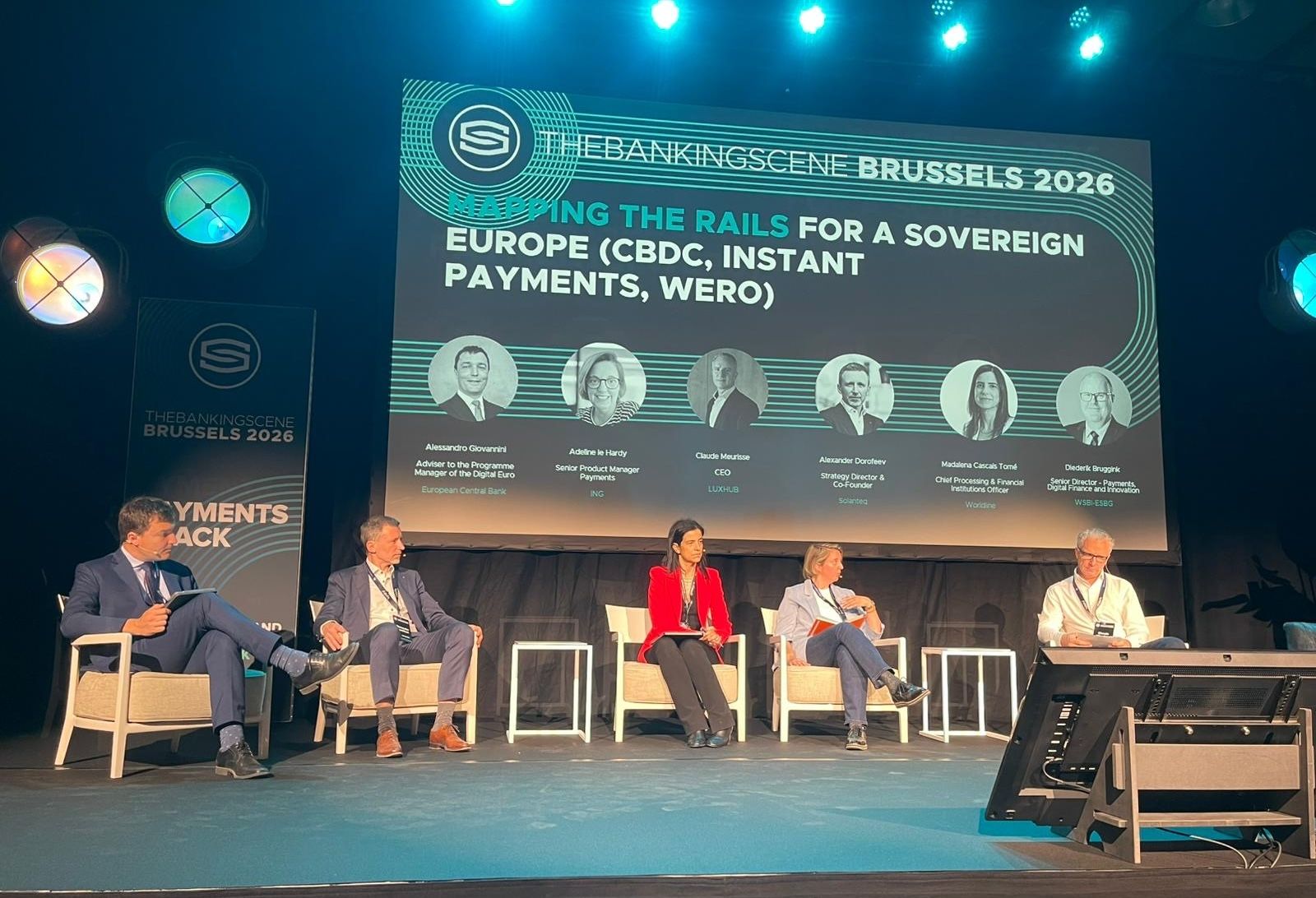
If there was one clear takeaway from the panel discussion “Mapping the Rails for a Sovereign Europe”, hosted by The Banking Scene at #TBSCONF26BXL in Brussels, it was this:
“The Digital Euro may look like another currency, but it is built on different principles. Traditional banking is based on accounts, balances and postings. The Digital Euro introduces wallet logic, new customer journeys, online and offline capabilities, and entirely new operational requirements.”
— Alexander Dorofeev, Co-founder & Director of Solanteq
That shift is not incremental. It is structural. And it has deep implications for how European banks will operate in the coming years.
A multi-rail future is already here
The payments landscape is no longer evolving around a single infrastructure.
Instant payments, card schemes, emerging payment networks, and central bank digital currencies (CBDCs) are converging into a multi-rail ecosystem. The challenge is no longer connectivity. It is orchestration.
The real challenge is not connecting to another rail. Most banks can do that.
The challenge is preventing every new rail from introducing another operating model, another set of processes, and another layer of complexity.
In a multi-rail world, competitive advantage will not come from connectivity alone. It will come from a bank’s ability to orchestrate fundamentally different payment models through a single architectural framework.
Why the digital euro is structurally different
Traditional banking is built on an account-based model: balances, postings, reconciliation, and settlement cycles.
The Digital Euro introduces a different paradigm altogether: a wallet-based model with:
- CBDC-specific holding rules;
- online and offline payment capabilities;
- new funding and defunding flows;
- different privacy and operational requirements.
For end users, this will likely feel seamless. For banks, it requires a different architecture.
The real challenge: two models of money
Banks are not simply adding another payment rail.
They are bridging two fundamentally different systems:
- account-based money;
- wallet-based central bank money.
Without careful design, this can lead to fragmentation across systems, operations, and customer journeys rather than simplification.
At the same time, this creates an opportunity to rethink payment architecture altogether.
The institutions that succeed will not be those that simply connect to more rails. They will be those that can reconcile fundamentally different models of money within a single operating framework.
The real question is no longer whether this shift is coming. It is how ready banks are to operate in a world where money no longer follows a single physics.
Accounts vs wallets. That is the real shift.