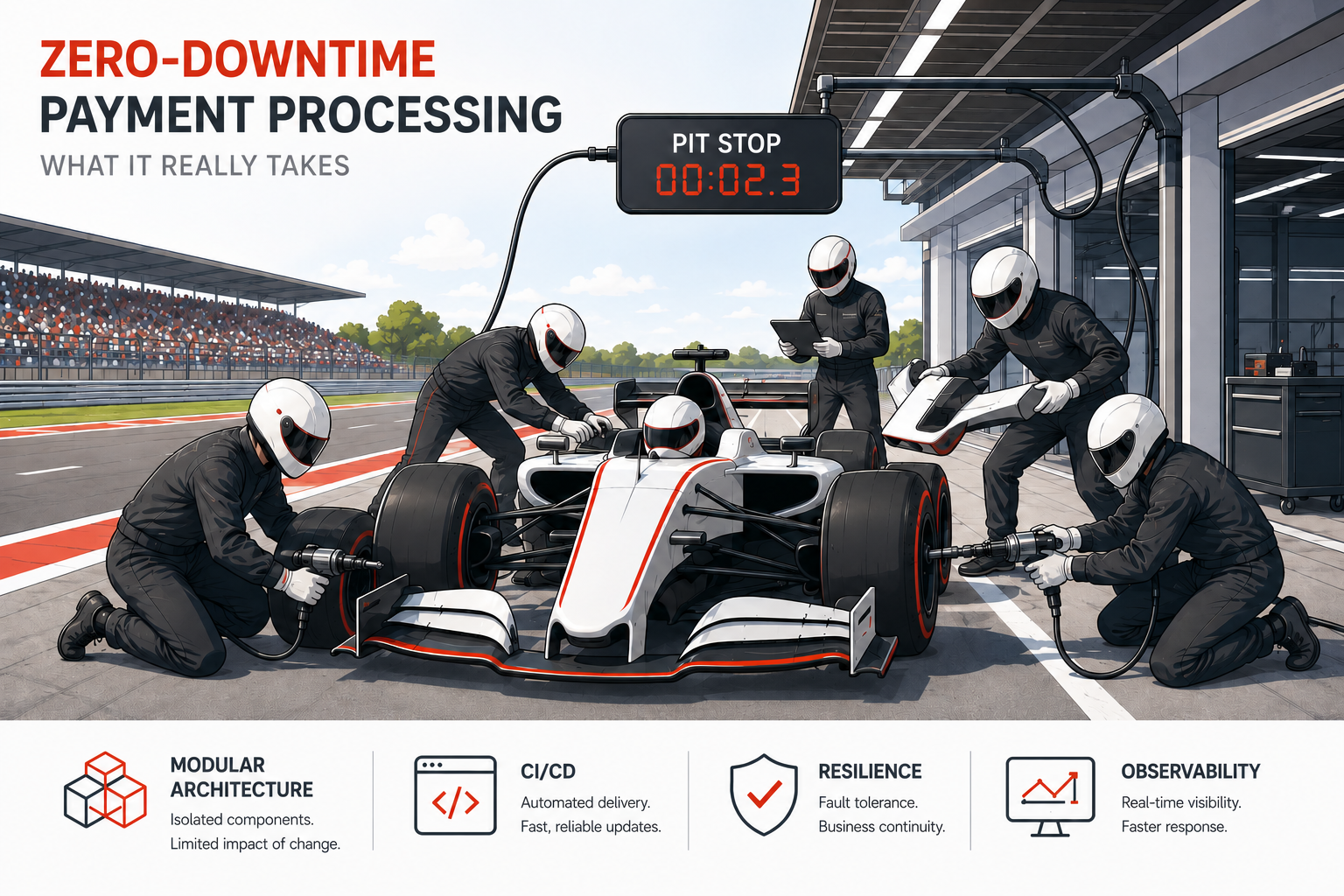
Zero-downtime payment processing: what it really takes
Most payment platforms can process transactions reliably. Keeping them running while introducing change is often much harder.
New releases, infrastructure upgrades, integration updates, security improvements, and regulatory changes all introduce risk. At the same time, payment services increasingly operate around the clock, leaving organisations with fewer opportunities to pause systems for maintenance.
This raises an important architectural question: how can a payment platform continue evolving while payments keep flowing?
The ability to introduce change without disrupting operations is the result of architecture, operational discipline, and platform design working together.
Why maintenance windows are becoming less practical
Scheduled downtime was once a normal part of operating payment systems.
Many organisations could plan maintenance activities during evenings, weekends, or other periods of lower transaction volume. As payment services expanded across digital channels, markets, and time zones, those windows became increasingly difficult to coordinate.
Today, customers expect continuous access to financial services. Merchants expect payment acceptance to remain available. Operations teams depend on real-time visibility into transactions and system activity. Even planned interruptions can have operational and commercial consequences.
Why continuous operations start with architecture
Zero-downtime capability is often associated with deployment tools or infrastructure platforms.
Those technologies are important, but they are only part of the picture.
The ability to update a platform safely depends heavily on how the platform is structured. Tight coupling between components increases release risk. Limited scalability creates operational constraints. Poor visibility makes issues harder to identify. Single points of failure can turn minor incidents into service interruptions.
Many availability challenges originate in architecture long before they appear in production.
This is one of the reasons SOLAR was designed around architectural principles that support continuous operations, including modularity, message-driven communication, deployment flexibility, resilience, and operational visibility.
Modular architecture reduces the impact of change
Not every change should affect the entire platform.
An update to an external integration should not introduce risk to transaction processing. A reporting enhancement should not require changes across unrelated services. A new feature should be deployed in a controlled manner without affecting critical payment flows. From a zero-downtime perspective, modularity is valuable because it limits the operational blast radius of change.
SOLAR separates core transaction processing, integration capabilities, and business-specific customisation into distinct platform areas. This helps limit the operational impact of change, making releases, updates, and platform enhancements easier to introduce without affecting unrelated services.
The objective is not to eliminate complexity. Payment platforms inevitably become more complex over time. The objective is to prevent that complexity from spreading unnecessarily across the platform.
Deployment flexibility supports continuous delivery
Payment organisations often operate across a combination of on-premises, private cloud, public cloud, and hybrid environments. Infrastructure strategies evolve, and deployment models change over time.
SOLAR supports containerised deployment models that help organisations manage services consistently across different environments. Combined with horizontal and vertical scaling capabilities, this provides greater flexibility when introducing updates, expanding capacity, or adapting infrastructure strategies.
The ability to add or replace service instances without interrupting the broader platform is an important part of supporting continuous operations.
Automated delivery reduces operational risk
Many service interruptions are not caused by software defects. They are often the result of operational mistakes. Complex release procedures, manual deployment activities, inconsistent environments, and undocumented operational steps all increase the probability of error.
SOLAR is designed to support automated delivery practices and CI/CD pipelines that help make deployment processes more predictable, repeatable, and controlled.
Reliable operations depend as much on process consistency as on technology choices.
Resilience extends beyond the platform itself
Even the most resilient payment platform depends on external systems. Banks, payment schemes, fraud prevention services, AML platforms, reporting environments, and infrastructure providers all influence the availability of payment services.
This makes resilience a broader challenge than application design alone.
SOLAR supports redundancy of critical external interfaces to reduce single points of failure and improve continuity when external dependencies experience issues. Combined with fault isolation and recovery planning, this helps limit the operational impact of disruptions beyond the platform itself.
Monitoring is essential for operational control
As payment environments grow, visibility becomes increasingly important.
More integrations, more services, and more transaction flows create more opportunities for hidden issues. Without effective monitoring, operational teams often discover problems only after customers, merchants, or other stakeholders are affected.
SOLAR incorporates centralised monitoring and operational visibility as core platform capabilities. Monitoring, event tracking, alerting, and transparency across platform components help teams understand system behaviour and respond to issues more quickly. The same capabilities support compliance and audit requirements by providing visibility into transaction flows, operational events, and system activity.
Disaster recovery remains part of the equation
Continuous operations and disaster recovery address different challenges, but they are closely related.
One focuses on introducing change without disruption. The other focuses on restoring services after significant incidents.
Both are necessary.
SOLAR supports disaster recovery planning as part of its broader resilience strategy, helping organisations prepare for infrastructure failures, service outages, and business continuity scenarios.
A mature payment platform should be prepared for both routine operational changes and unexpected events.
How SOLAR approaches continuous availability
Continuous availability in SOLAR is supported through a combination of architectural and operational capabilities:
- modular platform architecture;
- message-driven communication through RabbitMQ;
- containerised deployment support;
- horizontal and vertical scalability;
- CI/CD readiness;
- support for zero-downtime updates;
- redundancy of critical external interfaces;
- centralised monitoring and observability;
- disaster recovery planning;
- compliance and security by design.
Together, these capabilities help organisations introduce change with less operational risk while maintaining continuous payment operations.
Final thoughts
Over time, every payment platform accumulates new integrations, new operational requirements, and new dependencies.
The challenge is not avoiding change but introducing change without disrupting the services that depend on the platform.
A payment platform proves its resilience when it can absorb change without interrupting the services that depend on it. That is what zero-downtime payment processing really takes.