Building scalable payment infrastructure: key architectural decisions behind SOLAR
When discussing payment platform scalability, conversations usually focus on transaction volumes, infrastructure capacity, or system performance.
Those factors certainly matter. However, the challenges that limit scalability are not always related to transaction volume. They often appear when platforms become increasingly difficult to change, integrate, operate, or maintain as the business grows.
This perspective has shaped several of the architectural decisions behind SOLAR.
Scalability starts long before infrastructure limits
Scalability in payment technology is often associated with infrastructure capacity and transaction throughput.
In reality, many payment platforms encounter organisational and architectural limits long before they encounter technical ones. New products, integrations, regulatory requirements, and operational processes increase the number of dependencies across the platform. As a result, the effort required to introduce change often grows faster than transaction volume itself. In this context, scalability becomes not only a performance challenge, but an architectural challenge.
Managing complexity through modular architecture
This architectural challenge influenced several of the design principles behind SOLAR.
A payment platform consists of multiple areas that evolve at different speeds. Core transaction processing, integrations, reporting, operational workflows, and business-specific customisation all have different change cycles and business priorities.
When these areas become tightly coupled, every future change becomes more difficult.
SOLAR separates core transaction processing, integration capabilities, and business-specific customisation, allowing different parts of the platform to evolve without introducing unnecessary dependencies. This helps maintain stability in critical processing functions while providing greater flexibility in areas that change more frequently.
A key part of this approach is SOLAR’s message-driven architecture. Platform components communicate through an internal messaging bus based on RabbitMQ, helping reduce direct dependencies between modules and integration points. This allows different parts of the platform to process events, exchange information, and evolve more independently while maintaining consistent transaction flows across the solution.
Example of SOLAR’s architecture in an acquiring deployment. The platform’s modular components communicate through an internal RabbitMQ bus while integrating with external payment channels, customer systems, reporting platforms, and operational services.
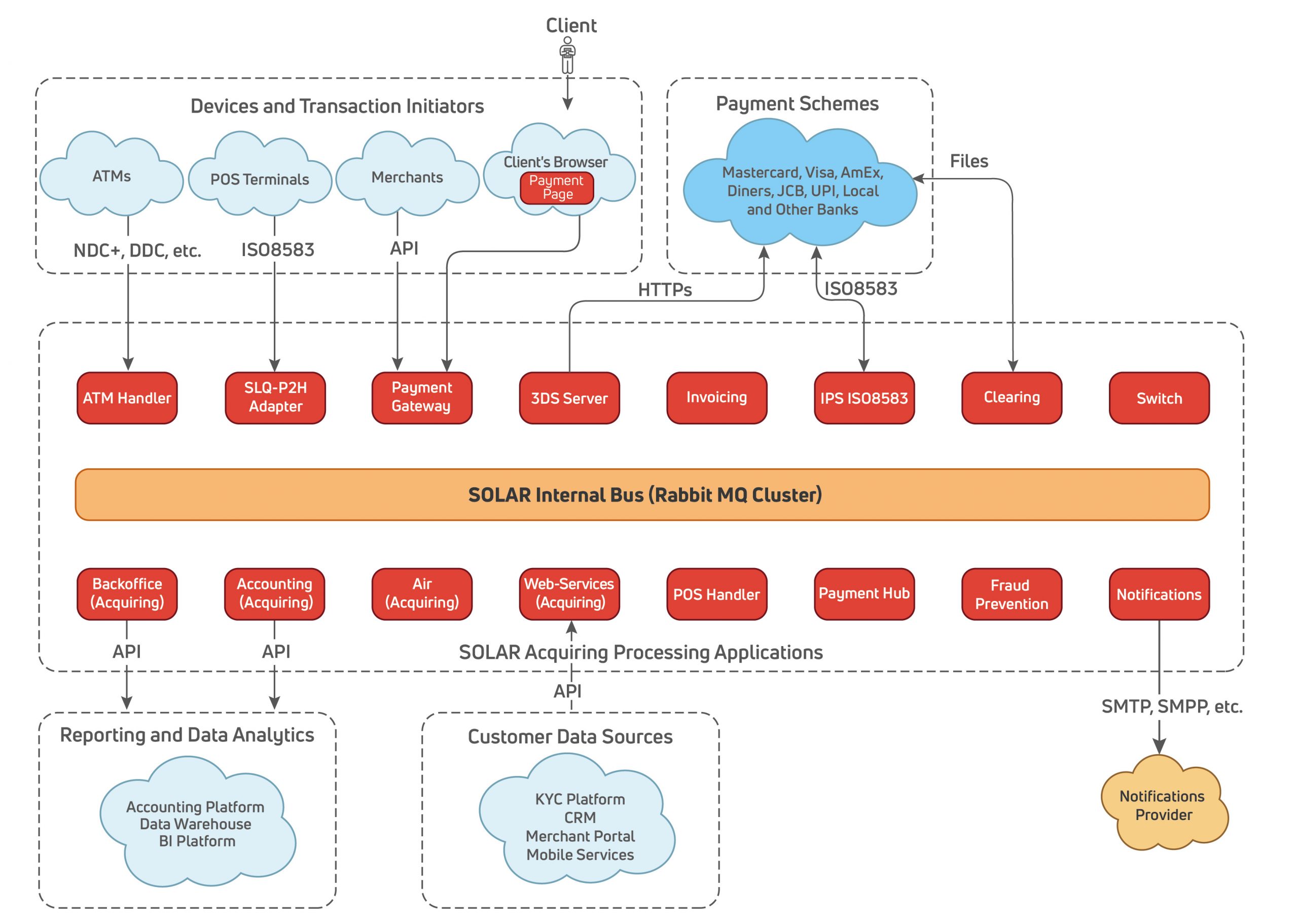
Modular architecture introduces clear boundaries between different platform capabilities. This helps organisations evolve specific areas of the platform without creating unnecessary dependencies across the broader solution, reducing the effort required to support future business and technology changes.
Designing integrations for long-term flexibility
Integration is often where complexity accumulates fastest.
Modern payment ecosystems require connectivity with banks, payment schemes, fraud monitoring systems, AML platforms, reporting solutions, digital channels, enterprise systems, and numerous third-party services. As the number of integrations grows, the integration layer can become more complex than the transaction processing engine itself.
For that reason, SOLAR follows an API-first and message-driven approach.
Rather than treating integrations as isolated implementation projects, platform capabilities are exposed through consistent and well-defined interfaces. The platform supports widely adopted standards and technologies, including ISO 20022, HTTPS APIs, Kafka, JMS-based integrations, and event-driven communication patterns built around RabbitMQ.
The combination of API-first and message-driven architecture also supports real-time information exchange across the platform. Events can be distributed between components as they occur, helping ensure that operational systems, channels, integrations, and processing services work with up-to-date information rather than relying on delayed synchronisation processes. This becomes increasingly important as payment ecosystems grow and business decisions depend on timely data.
Connectivity becomes more predictable, while the long-term cost of platform evolution is reduced.
Why database neutrality matters
Database neutrality is another architectural principle that helps preserve long-term flexibility.
By keeping business logic within application services rather than database-specific implementations, SOLAR reduces dependency on particular database technologies and infrastructure vendors. This gives organisations greater freedom when evolving infrastructure strategies, deployment models, and technology choices over time.
The benefits extend beyond portability. Future infrastructure decisions can be driven by business requirements rather than architectural constraints.
Building for continuous availability
Continuous availability has become a fundamental requirement for modern payment platforms.
Payment services increasingly operate on a 24/7 basis, with customers, merchants, and partners expecting uninterrupted access regardless of time zone or business hours. Even short periods of downtime can have operational, financial, and reputational consequences.
Continuous availability therefore cannot be treated as a standalone feature. It is the result of multiple architectural decisions working together.
In SOLAR, continuous availability is supported through containerisation readiness, horizontal and vertical scaling, automated deployment practices, centralised monitoring, redundancy of critical external interfaces to reduce single points of failure, and disaster recovery planning designed to support business continuity during infrastructure or service disruptions. Together, these capabilities help ensure that the platform can continue evolving while payment operations remain uninterrupted.
Deployment flexibility plays an equally important role. Architectures that support deployment across on-premises, private cloud, public cloud, and hybrid environments provide organisations with greater freedom to adapt without redesigning core payment services.
SOLAR also supports platform upgrades during regular business hours through its zero-downtime upgrade approach and Configuration Replicator technology, helping reduce dependency on traditional maintenance windows.
Why observability matters at scale
As platforms become larger and more interconnected, identifying problems becomes more difficult.
New services, integrations, and transaction flows increase operational complexity, making visibility essential. Without sufficient observability, issues often remain hidden until they begin affecting business operations.
Centralised monitoring and operational visibility are built into the way SOLAR is operated. Monitoring, event tracking, alerting, and transparency across platform components help organisations understand system behaviour and identify issues before they affect customers or operational teams.
These capabilities also support compliance and audit requirements. As regulatory expectations continue to grow, organisations need reliable visibility into transaction flows, operational events, and system behaviour. Observability therefore contributes not only to operational resilience, but also to regulatory readiness.
Final thoughts
Over time, every payment platform accumulates new integrations, new operational requirements, and new dependencies. The question is whether the architecture remains manageable as that complexity grows.
That is why the fundamental challenge of payment platform architecture is balancing growth with control.
This principle has guided the design of SOLAR from the beginning. The aim is not only to support growth, but to keep that growth manageable.